When you are building software that organisations actually depend on, the technology choices you make on day one carry consequences for years. We have shipped portals, intranets, ERP integrations, and automation platforms across multiple business entities. After enough cycles of building, debugging, and maintaining, our stack has converged on a clear answer: Next.js on the front end, Python on the back end, and a deliberate set of architectural principles holding the two together.
This is not a trending-frameworks post. It is a practitioner's account of why this combination holds up when projects graduate from prototypes to production systems that real users depend on every single day. We cover what enterprise-ready actually means, why each layer earns its place, how the two fit together, and where the stack stops being the right choice.
What "Enterprise-Ready" Actually Means
Before arguing for any stack, it helps to define enterprise-ready in practice rather than in a sales deck. For us it comes down to a few non-negotiable properties:
- Maintainability — the application can be handed to a team that did not build it and extended without a full rewrite.
- Scalability — the system absorbs load spikes without manual intervention.
- Modularity — new features can be added without disturbing unrelated parts of the codebase.
- Security and observability — access control, logging, and monitoring are first-class concerns from the start, not bolted on later.
The core insight: enterprise-ready is not about the technology itself. It is about how predictably that technology behaves when the requirements change, the team changes, and the traffic changes.
Next.js: The Front End That Does Not Fight Your Back End
We evaluated most of the major front-end options. Create React App is effectively retired. Vue is solid, but its enterprise ecosystem is thinner. Angular has the structure but carries a learning curve and verbosity that smaller teams feel acutely. Next.js sits in the right place: the full power of React, with routing, rendering strategies, and a deployment model that maps cleanly onto how enterprise applications actually need to work.
Rendering Strategies on a Per-Page Basis
Not every page has the same needs. A public product catalogue benefits from static generation and SEO; a user-specific dashboard must render per request. Next.js lets us choose the right strategy page by page without stitching two frameworks together.
- Static Generation (SSG) — pre-rendered at build time for marketing pages and documentation.
- Server-Side Rendering (SSR) — rendered per request for personalised, authenticated views.
- Incremental Static Regeneration (ISR) — static performance with periodic background refresh for semi-dynamic content.
API Routes as a Lightweight Integration Layer
One of the underrated features of Next.js in an enterprise context is its built-in API routes. When you need a thin proxy between the front end and a third-party service, such as a Business Central OData endpoint or a Microsoft Entra token exchange, you do not need to stand up a separate Express server. A Next.js API route handles it inside the same codebase, the same deployment pipeline, and the same environment configuration.
// app/api/bc/customers/route.ts
import { NextResponse } from "next/server";
import { getBCToken } from "@/lib/bc-auth";

export async function GET() {
  const token = await getBCToken();        // cached OAuth2 client credentials
  const res = await fetch(
    `${process.env.BC_BASE_URL}/api/v2.0/companies(${process.env.BC_COMPANY_ID})/customers` +
    `?$select=number,displayName,email,balance`,
    { headers: { Authorization: `Bearer ${token}` } }
  );
  const data = await res.json();
  return NextResponse.json(data.value);
}
TypeScript by Default
We write Next.js in TypeScript without exception. The upfront discipline of typed interfaces pays back immediately during refactoring and onboarding. When a Business Central API response changes shape, a typed interface surfaces it as a compile-time error rather than a runtime crash in production.
Python: The Back End That Punches Above Its Weight
Python's reputation in data science sometimes obscures how strong it is for back-end API work. FastAPI in particular has changed the calculus. It delivers automatic OpenAPI documentation, Pydantic-based request validation, native async support, and performance that comfortably covers the vast majority of enterprise workloads, all in a syntax a new team member can read on their first day.
Auto-Generated Contracts Eliminate Documentation Drift
A persistent friction point in enterprise development is documentation drift: the spec says one thing, the code does another. FastAPI removes much of that gap by generating an OpenAPI specification directly from the code itself. When the Next.js front end calls a Python endpoint, the contract is explicit, versioned, and always accurate, which matters enormously when the person maintaining the front end did not write the back end.
from fastapi import FastAPI, HTTPException
from pydantic import BaseModel
from typing import Optional

app = FastAPI()

class CustomerQuote(BaseModel):
    customer_id: str
    items: list[dict]
    discount_pct: Optional[float] = 0.0

@app.post("/quotes", status_code=201)
async def create_quote(payload: CustomerQuote):
    if not payload.items:
        raise HTTPException(status_code=400, detail="Quote must contain at least one item")
    quote_id = await quote_service.create(payload)
    return {"quote_id": quote_id, "status": "draft"}
An Unmatched Integration Ecosystem
Python's library ecosystem for enterprise integration is genuinely hard to beat. For almost any commodity requirement there is a stable, well-maintained library, which means we rarely build infrastructure ourselves.
- SQLAlchemy — robust ORM and query layer for PostgreSQL and MSSQL.
- openpyxl / pandas — parsing complex spreadsheet uploads and data transformation.
- msal / requests — Microsoft Graph and Business Central authentication and calls.
- Celery — scheduled jobs and background task queues.
- scikit-learn — lightweight models for anomaly detection and forecasting when needed.
How the Two Layers Fit Together
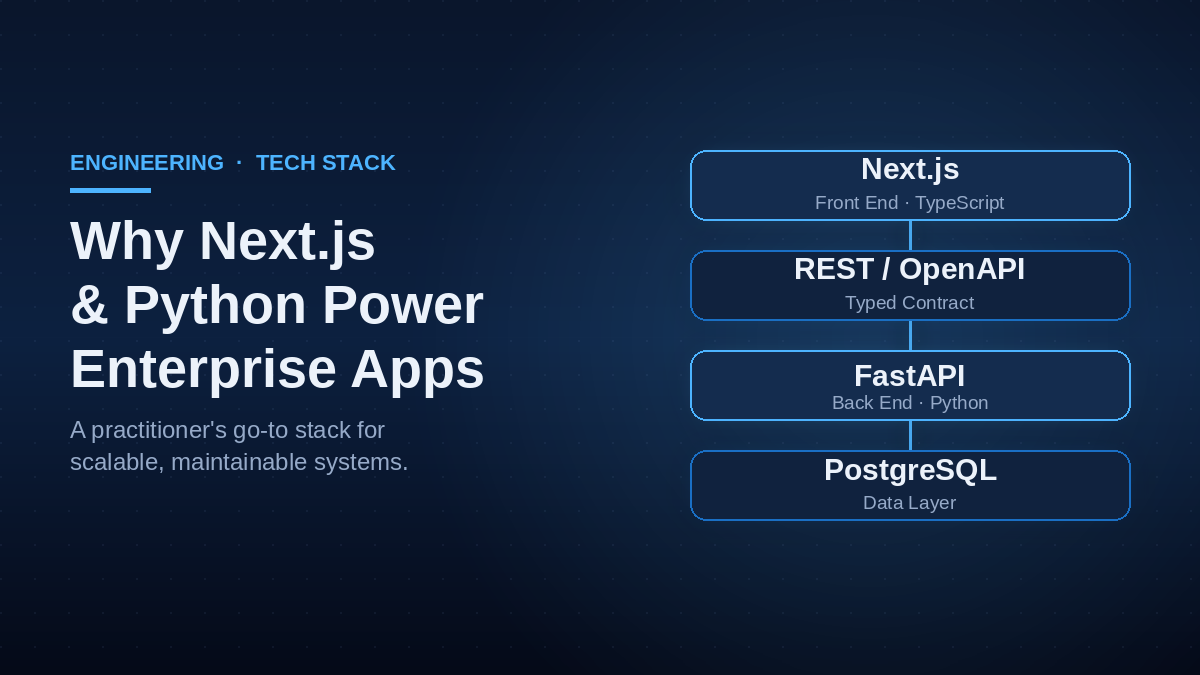
The key architectural decision is keeping the layers cleanly separated by an API boundary. The Next.js application never touches the database directly. The Python service never renders HTML. Each layer can be scaled, replaced, or redeployed independently.
| Layer | Technology | Responsibility |
|---|---|---|
| Front end | Next.js (TypeScript) | Pages, components, auth, API proxy routes |
| Contract | REST / OpenAPI | Typed interface shared between front and back end |
| Back end | FastAPI (Python) | Business logic, integrations, background tasks |
| Data | PostgreSQL / MSSQL | Relational storage via SQLAlchemy |
| Infrastructure | Ubuntu VPS / Azure / Docker | Reverse proxy, process management, CI/CD |
That separation has repeatedly saved effort: a front-end redesign can ship without touching back-end logic, and a back-end performance fix can go out without touching the UI.
Where This Stack Has Held Up in Production
This is not theoretical. The same combination underpins several systems we run today.
- GRMS Intranet — Next.js and Python on a self-hosted Ubuntu VPS with PostgreSQL, serving multiple departments across three entities with role-based access.
- Dealer and HR Portals — Next.js front ends backed by Python APIs integrating with Business Central via OAuth2 and OData for quotes, document upload, and record views.
- GR AVA (in-house AI assistant) — a Python back end orchestrating LLM calls and internal knowledge retrieval, surfaced through a Next.js chat interface with real-time streaming.
- Client delivery at City Project Solutions — custom enterprise applications built on the same stack, deployed on Azure with environment-based configuration management.
Where the Stack Is Not the Right Choice
Being honest about limitations matters as much as listing strengths.
- Very high-concurrency real-time apps — for thousands of simultaneous socket connections, Node.js on the back end is often a better fit than Python.
- Tiny internal tools — for a ten-user utility, a full Next.js setup with API routes doing all the work avoids the overhead of running two languages.
- Solo or very small teams — two languages and two deployment targets add cognitive load that a single-language stack avoids.
The honest bottom line: choose boring, proven technology for the foundations and spend your innovation budget on the problems that actually differentiate your product. The stack should be the least interesting part of what you build.
Getting Started: A Sensible First Build
- Scaffold a Next.js app in TypeScript and define your page-level rendering strategy up front.
- Stand up a FastAPI service with one endpoint and confirm the auto-generated OpenAPI docs render.
- Define the API contract first — shared types between front and back end before writing UI.
- Add PostgreSQL via SQLAlchemy and keep all database access behind the Python layer.
- Containerise both services and wire up a simple CI/CD pipeline before the codebase grows.
Closing: Reliability Compounds
Next.js and Python are not the newest or flashiest choices on any given week. They are the choices that have consistently let us ship reliable, maintainable software on real deadlines with real teams. The ecosystems are stable, the hiring pool is large, the documentation is excellent, and community support is there when you hit the edge cases.
For enterprise applications that need to be running in three years and maintained by people who were not in the room when they were built, that reliability is worth more than any benchmark. Start with the simplest version that solves your problem, ship it, and let the foundation grow with you.